


Is the Knuckleball an Endangered Species?
By Mike Silva ~ April 25th, 2012. Filed under: MLB News.
On Saturday, I attended a screening of Knuckleball! at the Tribeca/ESPN Sports Film Festival. The documentary, by award-winning filmmakers Ricki Stern and Annie Sundberg, follows knuckleballers R.A. Dickey and Tim Wakefield during the 2011 season. Stern and Sundberg also tell the story about how both pitchers came to embrace and master this unique pitch. Charlie Hough, Phil Niekro, Jim Bouton and long-time White Sox lefty Wilbur Wood all made cameos to discuss this “trick pitch.”
“To gain power you first must give up control,” is the tagline on the movie poster. The pitch that sometimes travels slower than the speed limit on a State Highway eludes many who have attempted to master it. Wakefield and Dickey are two of the luckier ones that saved their career by embracing it and executing at a high level. Wakefield retired before the season and finished with 200 wins for his career. R.A. Dickey is in his third season with the Mets and has been throwing the pitch since 2005. After becoming a member of the Mets rotation in 2010, he’s pitched well enough to be considered a top-10 pitcher in the National League. Despite the success of these two recent knuckleballers, I think the future of the pitch is very murky. With a game that is obsessed with power, strength and speed, it could be that Dickey will be the last member to carry the torch of this small fraternity. I also wouldn’t be surprised if we are seeing the final days of the pitch.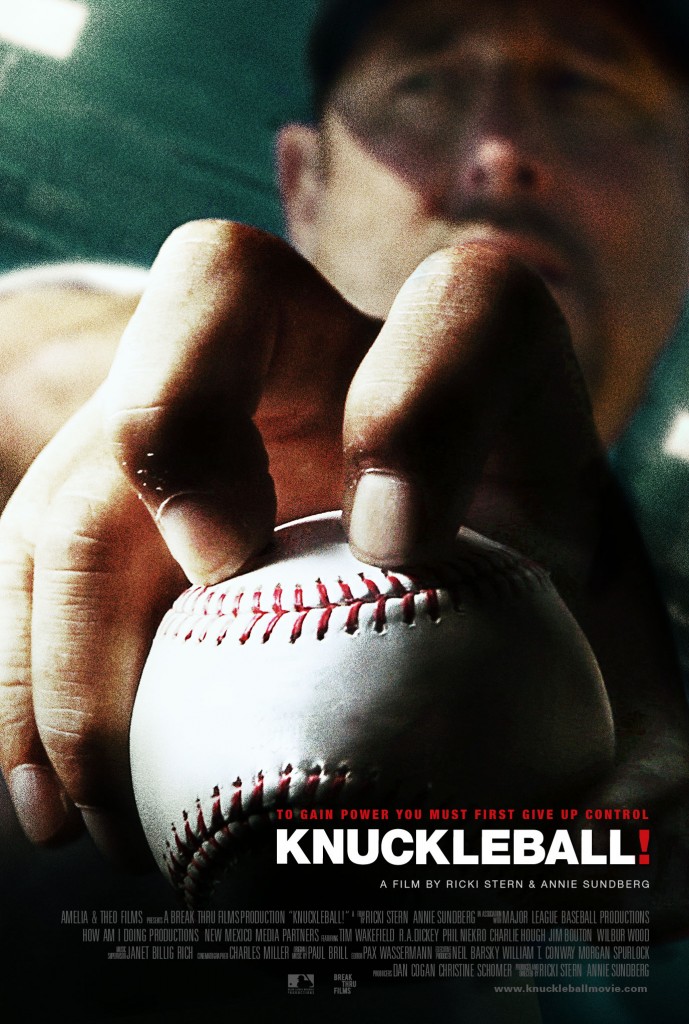
Turn back the clock just 25 years ago. Hough, Tom Candiotti and the Niekro brothers were all top-of-the-rotation pitchers for their respective teams. A decade earlier, Wilbur Wood had four straight seasons of 20 wins or better. Of course we can’t forget Hoyt Wilhelm, a Hall of Famer. Today, outside of Dickey, there is no one even close to being an established knuckleballer. Charlie Zink made one start for Boston in 2008. Charlie Haeger had a couple of brief cups of coffee with the Dodgers in 2009 and 2010. Neither was good enough to stick around very long.
So is there anyone on the horizon? One minor leaguer to keep an eye on is Steven Wright, a right handed knuckleballer with the Indians. He converted last season and is throwing the pitch 85% of the time. After bouncing around three minor league levels and posting an unsightly WHIP of 1.6 and walk-rate close to 5, Wright has pitched well thus far this year; going 2-1 with a 1.56 ERA in 3 starts for the Indians Double-A affiliate. His walks are still high (5.2 per 9), but he’s struck out nearly 10 batters per 9 innings. When mastering a “trick pitch” progress can’t be sneered at.
The Indians actually endorsed Wright going full-time with the knuckleball after Candiotti watched him throw. With all the organizational fillers throughout the game, wouldn’t it make sense for every team to be progressive with the pitch? “Being on the other side, in the management side, I’m not looking for a guy that can throw a knuckleball. I don’t know of any big league manager that’s going ‘boy, I wish I had a knuckleballer on my team’,” Hough, now senior adviser of player development for the Dodgers, told me during a recent interview. “We’ve only got so many innings per year for our prospects to pitch. It’s difficult to give some of those innings to somebody kind of on an experiment.”
I would counter that there is a value to dedicating innings to this “experiment.” Having a pitcher on the staff that could eat innings and throw everyday has value. Even if the ceiling for that prospect is a league average hurler that gives you 200 innings with a 4.50 ERA, I think it’s worth it. How many kids throwing 95-mph would die for that type of pitching profile?
You also don’t have to contain it to failed pitchers. Wakefield was a first baseman that was coming off a season where he hit .216 with 1 home run in Low-A; not the kind of numbers that keeps you employed in a big league organization. It’s not like you have to spend money on scouting for the next great knuckleballer (Phil Niekro was actually drafted strictly throwing the pitch), you can find one amongst the scraps in your own organization. The one issue would be having someone run such a program since there aren’t many knuckleballers left, and Hough is already employed.
Hough also believes Dickey he could pitch another ten years. If that comes to fruition, there is plenty of time for the next big league knuckleballer to join him. If Wright continues to improve he may be the most likely candidate. If not, then we may be seeing the last of the knuckleball, which I think would be a shame.







Latest posts by Mike Silva (see all)
- Listen: WFAN’s Sweeny Murti on 2014 Yankees - March 31, 2014
- SNY’s Rich Coutinho Previews 2014 Mets - March 31, 2014
- Yanks Spending Spree Gets Them “In the Mix” - March 30, 2014
April 25th, 2012 at 11:33 am
I’ve always wanted to ask Wood why so few lefties become knuckballers. He was the only prominent one that I know of.
April 25th, 2012 at 12:05 pm
Asked Hough in the interview and he said there is no reason for that other than coincidence, in his opinion
April 25th, 2012 at 12:54 pm
Very interesting article. Certainly a subject that isn’t discussed often.
I’ll keep an eye out for that documentary.
Thanks Mike
April 26th, 2012 at 1:14 am
Lol I don’t consider Dickey a top 10 pitcher but it is a shame that they are a dying breed
April 26th, 2012 at 4:37 pm
It never occurred to me that knuckleballers tend to be right-handed. My guess is that it’s because left-handed pitchers are rarer and inherently more valuable to start with. There is a greater chance of a marginal lefty making it with “standard stuff,” and therefore less likelihood that one will turn towards an alternative pitching style.